Action Alert: No laws to protect Canadian livestock rabbits
Rabbit Rescue Inc. has launched a campaign to Ensure Compassion and Respect for Rabbits Everywhere (C.A.R.E). Its goal is for the Federal Minister of Agriculture and Agri-Food to develop Codes of Practice to include farmed rabbits and to make changes to the Humane Slaughter Act.
Read the background information
To take action on this important issue visit Rabbit Rescue's website: http://www.rabbitrescue.ca/care.html
Our letter:
- Carmina Gooch, President
- Rabbit Advocacy Group of BC
- address www.rabbitadvocacy.com
February 5, 2009
Re: Rabbits and the Humane Slaughter Act
Dear Sir:
I am writing to express my deep concern that while most food animals are somewhat ‘protected’ by voluntary Codes of Practice that farmers are encouraged to follow, rabbits are totally overlooked. There are no laws that require they be given minimum amounts of feed, water, or care. No basic humane standards at all while exploited as product by an archaic industry synonymous with tremendous pain and suffering.
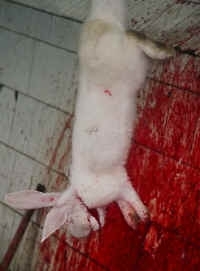
What’s more, the Humane Slaughter Act doesn't even mandate that rabbits be rendered unconscious prior to being suspended for slaughter. Can you imagine being butchered alive? Rabbits struggle and cry while fighting for their lives. Why aren't there any regulations that offer even minimal protection during the farming process?
Surely we can't let this barbaric cruelty go on any longer. Our antiquated laws pertaining to livestock need to be amended (and enforced) now, in recognition of changing times and attitudes toward all those sentient beings giving their lives for us, rabbits included.
I urge this government to take immediate action on such an important issue that affects all of us and look forward to hearing from you.
Sincerely,
- Carmina Gooch
- North Vancouver
Cc: Andrew Saxton, M.P
Honourable Ron Cantelon, BC Minister of Agriculture and Lands
Rabbit Rescue Inc.
March 25, 2009: Response from Gerry Ritz, PC, MP, to concerns regarding Fraser Valley Auctions and to food rabbits not being included in the voluntary Codes of Practice farmers are encouraged to follow.
Dear Ms. Gooch:
Thank you for your email and letter expressing your concerns regarding the humane treatment of animals and the situation at Fraser Valley Auctions.
I appreciate your concern for the welfare of animals. As a former horse breeder myself, I also believe that animals should be protected from unnecessary suffering, and I can assure you that most Canadian producers and industry members are strongly committed to treating animals with care.
The Canadian Food Inspection Agency’s (CFIA) role is to enforce the regulations under the Health of Animals Act that govern the humane transportation of animals and to ensure that farm animals are humanely slaughtered in federally registered meat plants, as required under the Meat Inspection Act.
The main responsibility for the welfare of animals on-farm rests with the provinces and territories. In British Columbia, the Society for the Prevention of Cruelty to Animals (SPCA) enforces the provincial laws that govern the humane treatment of animals. SPCA officers or police officers also investigate complaints under the federal Criminal Code.
Animal cruelty is unacceptable under the Criminal Code, and penalties provide an important deterrent. I am pleased to tell you that on April 9, 2008, the Government of Canada was successful in ensuring that Bill S-203 passed. This bill amends the Criminal Code to significantly increase penalties to enhance sentencing options available to the courts and to send a strong message that the federal government does not tolerate animal cruelty.
I wish to assure you that the CFIA has maintained a regular presence at Fraser Valley Auctions for the past several years. The CFIA attends auctions in an oversight capacity and notifies the British Columbia SPCA when concerns are raised about how animals are handled in the pens or in the ring. Incidents related to loading, unloading or transport come under the Health of Animals Regulations. The CFIA also takes time to educate and remind individuals delivering animals to auctions of their obligations to the well-being of their animals.
Officials of the CFIA and of the British Columbia SPCA have met on more than one occasion to discuss the events at Fraser Valley Auctions, and they continue to collaborate concerning the humane treatment of animals.
I note your comments about the Recommended Codes of Practice for the Care and Handling of Farm Animals. These codes have been developed as a collaborative effort of many stakeholders from Canadian industry, government and non-governmental organizations. The codes are now being coordinated and maintained by the National Farm Animal Care Council (NFACC). However, the initiation of code development and revision for a species remains the responsibility of each individual commodity group. The NFACC has established a protocol and guidelines for the development and revision of the codes, including that recommended practices should be based on sound science and be practical and manageable.
You are correct in stating that the code of practice for food rabbits has not yet been developed. It is not possible to determine when one might be completed. For further information, you may wish to contact the following NFACC official:
- Ms. Jackie Wepruk
- Coordinator
- National Farm Animal Care Council
- PO Box 61324, RPO Brentwood
- Calgary, Alberta T2L 2K6
As I previously indicated, there are laws in place that set standards for the humane handling and slaughter of animals in federally registered abattoirs. The Meat Inspection Regulations ensure that rabbits and other animals are rendered unconscious as humanely as possible before slaughter.
There is only one federally registered establishment that is slaughtering rabbits, and I assure you that it has been operating in compliance with humane standards. Some rabbit slaughter is done in British Columbia in provincial establishments. The Province has a long-standing memorandum of understanding designating the CFIA as the provider of inspection services in British Columbia, and you can be assured that rabbits are being slaughtered humanely at these provincial establishments.
I trust that this information will be of assistance to you. Again, thank you for bringing your concerns to my attention.
Comment: Please contact the National Farm Animal Care Council and be a voice for the rabbits. Online input form http://nfacc.ca/
Read more:
Meat Inspection Regulations Canada/Rabbits
Meat Inspection Regulations Canada CFIA: Poultry and Rabbit Species

Farm animal transportation death toll; CFIA vs Maple Lodge
Meat rabbits and some statistics; no laws to protect
End the Cage Age - Make farming rabbits in cages illegal!
March 26, 2009 Carmina Gooch, Rabbit Advocacy Group of BC, sent the following letter:
- To: Jackie Wepruk, Coordinator
- National Farm Animal Care Council
- Re: Rabbits and the Codes of Practice
- for the Care and Handling of Farm Animals
Dear Ms Wepruk:
The Rabbit Advocacy Group of BC is writing with concerns regarding the absence of regulations specific to meat rabbits in the Codes of Practice for the Care and Handling of Farm Animals.
There are no basic standards that would ensure the humane handling and treatment of these animals while they await slaughter.
We are given to understand that the NFACC is the organization responsible for assisting with the Codes of Practice development process and that the Code has not yet been created.
When might we expect that it will be completed? The welfare of rabbits is of equal importance to that of other animals exploited for the food industry.
We look forward to hearing from you
regarding this issue. 
Sincerely,
April 8, 2009 Response from Jackie Wepruk, NFACC
Dear Carmina,
Thank you for your letter
and email regarding the humane treatment of rabbits. You are correct
that there has been no Code of Practice for the care and handling of
rabbits developed in
The National Farm Animal Care Council (NFACC) does not develop Codes of Practice independent of the industry involved. In fact, the first step in developing a Code of Practice is for the national commodity group to contact NFACC and indicate its interest in developing a Code (see www.nfacc.ca NFACC’s Development Process for Codes of Practice).
Some provincial rabbit associations exist, but it should be the national association that takes the lead in developing a Code of Practice for the entire industry. I am not aware of the existence of a Canadian rabbit association representing the interests of the rabbit industry nationally, but that would be a first step in addressing the need for a national Code of Practice for rabbits.
In addition, ongoing funding support for Canada’s Code of Practice development process is still needed. NFACC has updated and approved a new development process for Codes, but support to update or develop Codes of Practice for all farmed species has not been secured. NFACC has been working with the Agriculture and Agri-Food Canada to identify funding options, but no path forward has been identified yet.
With regard to your
concerns around humane slaughter, rabbits are included under Canada’s federal Meat
Inspection Act and Regulations. The Canadian Food Inspection Agency (CFIA)
is responsible for the administration and enforcement of this
regulation. NFACC has no authority under any Acts or Regulations, so
your concerns are best directed to CFIA on this matter.
June 22, 2009 The
BC SPCA and CFHS were contacted with regard to our concerns that no Code
of Practice has been developed by the NFACC. Just recently the Code for
Dairy Cattle was amended and as humans continue to exploit lives as
resources to please our palate, it is of utmost importance the
consideration of sound standards and animal welfare policies apply to
all livestock. While this doesn't alter the fact that the end result is
the same, inhumane and cruel conditions and treatment of those who
sacrifice their lives is intolerable. Geoff
Urton, Farm Animal Welfare Coordinator for the BC SPCA , responded that
Dairy Cattle was the "pilot" Code under the new process that was
recently developed, and other industries such as beef cattle, pigs, and
horses, have lined up to revise their Codes. Rabbits would have to fall
into the queue. Hugh Coghill, of the O SPCA, and who represents the BC
SPCA on the NFACC confirmed that "other commodities will take priority"
in the revision process, and added that it is essential that the rabbit
industry keep pressure on the NFACC so that a Code for the handling of
rabbits can be set in sequence so that there's a date to work toward.
It is unlikely that rabbits will be addressed within the next couple of
years.
Jackie Wepruk, NFACC Coordinator recently communicated to us that she is
unaware of a Canadian rabbit association representing the interests for
the entire industry nationally. (see above response)
April 2011 The Codes of Practice
for the care and handling of farm animals have set minimum standards for farm animal welfare across the country for over two decades. Each code, developed by a committee of industry, government and animal welfare representatives, lays out the minimum standards of animal care that producers or transporters are expected (but not required) to adhere to in their particular industry. In other words, they are voluntary. What we need are Mandatory Codes of Practice across the country. While codes are referenced in some provincial cruelty or protection laws, there is no on-farm assessment to verify they are being adhered to.From B.C.’s Prevention of Cruelty to Animals Act (PCA Act) RSBC 1996, Chapter 372
24 (1) A person responsible for an animal who causes or permits the animal to be or continue to be in distress commits an offence.
(2) Subsection (1) does not apply if the distress results from an activity that is carried on in accordance with reasonable and generally accepted practices of animal management.
NFACC revised codes for dairy cattle were completed in 2009. Codes currently under revision are beef cattle, equine, pigs, mink, ranched fox, and most recently sheep, the update initiated in Jan. 2011.
The review and update of the Code of Practice for chickens, turkeys and breeders will begin in October. The National Farm Animal Care Council (NFACC) has been requested by the Turkey Farmers of Canada (TFC), Chicken Farmers of Canada (CFC), Canadian Hatching Egg Producers (CHEP) and Canadian Poultry and Egg Processors Council (CPEPC) to initiate the review.
Industry groups representing rabbits have made no effort to start the process of having codes for their species, speaking volumes about the integrity and trustworthiness of the producers. (The BCFACC was formed in 2009.) No minimal standards for animal welfare and no oversight. Perhaps it’s time for video surveillance systems and independent monitoring.
More and more people are giving up unhealthy,
cruelly produced food and moving toward a modern, compassionate, and
healthy cruelty-free plant based diet, despite government and industry
attempts to hinder the growing movement. Our tax dollars are being used
to encourage consumption of animals and animal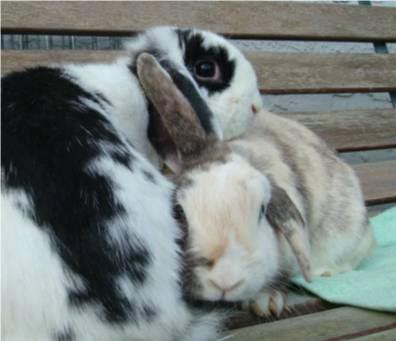 products.
Note: We purchased these two rabbits from the Fraser Valley Auctions in Langley in early 2011. Both were sick and pregnant. Sadly, this is not unusual.
Although amendments to the BC PCA Act became law on June 2, 2011, in reality there was little change. Industry/producers are protected under legislation whereas animals are not. The customary and acceptable “standards of care” are in fact a hell on earth – let’s not kid ourselves.
The PCA Act Part 4 Defence 24.02 A person must not be convicted of an offence under the Act in relation to an animal in distress if:
(b) the person is an operator, the distress results from an activity that is carried out in accordance with the prescribed standards of care that apply to the regulated activity in which the operator is engaged, or
(c) the distress results from an activity that is carried out in accordance with reasonable and generally accepted practices of animal management that apply to the activity in which the person is engaged, unless the person is an operator and those practices are inconsistent with prescribed standards.
October 15, 2014 We received a response to our concerns regarding the suspension of rabbits for slaughter here in BC and were advised that “there are currently only two provincial slaughter establishments in BC that slaughter rabbits and the suspension of those rabbits prior to stunning is not allowed. The BC Meat Inspection Program follows best practices and encourages high standards for animal welfare and humane stunning and slaughter methods on all species.” (and we’re expected to believe this?)
November 7, 2014 Carmina Gooch wrote to agriculture ministers and farm animal council managers regarding rabbit welfare concerns in the meat industry.
November 27, 2014 update: In response to our concerns regarding welfare standards of farmed rabbits, Jackie Wepruk, GM of the NFACC noted that: A few provincial associations exist, most with a largely volunteer-base. A national rabbit association is not in place. Coordinating the development of a national Code of Practice is a significant effort. Dedicated resources are required to coordinate the industry and assure its involvement from start through to the successful completion of a Code. NFACC’s rigorous Code development process requires this. There is a desire from within the sector for a rabbit Code of Practice. However, time is needed to ensure the necessary organization of the industry and its ability to remain actively engaged throughout the process, as well as to secure the necessary industry resources that will ensure the development of a successful Code that furthers the welfare of rabbits across Canada.
Agriculture Minister, Gerry Ritz, had also advised that the process would have to be “balanced against competing priorities.”
December 24, 2014 comment: Further to our questions and concerns regarding farmed rabbit welfare, Mr. Ritz advised that the Government of Canada is providing funding assistance of up to $5.4 million to the National Farm Animal Care Council to develop and update the Codes of Practice to ensure the welfare of farmed animals.
With regard to “humane slaughter,” the Meat Hygiene Manual of Procedures, which is used to help inspectors and industry to interpret the regulations, states that suspending conscious rabbits is no longer an acceptable practice. www.inspection.gc.ca/food/meat-and-poultry-products/manual-of-procedures/chapter-12/animal-welfare-requirements/eng/1392144659190/1392144660111?chap=3.February 16, 2015 Development of Canada’s first national Code of Practice for Rabbits has begun
Comment: The Rabbit Advocacy Group of BC has contacted and met with various politicians and other representatives, including those from the BC SPCA, requesting that the welfare of rabbits bred and raised for the meat industry be addressed. Codes are now underway and will take at least two years to complete.
 We would like to remind
everyone that the overwhelming majority of “food” animals live and die
in misery and are deprived of their right to life. There is no such
thing as humane slaughter and oversight is lacking.
We would like to remind
everyone that the overwhelming majority of “food” animals live and die
in misery and are deprived of their right to life. There is no such
thing as humane slaughter and oversight is lacking.
If you haven’t done so already, join the millions who have already embraced an ethical and healthy plant-based diet.
January 31, 2017 First Rabbit Code of Practice released by NFACC. Open for public comment until March 31, 2017. Please take a few moments to respond as the NFACC is industry-controlled.
Take part in the NFACC’s survey. You can also copy and paste the BC SPCA’s submission (link no longer active) for your comments. Sign: Stop the Torture of Rabbits in Canada. It’s that easy to make a difference in the lives of rabbits exploited for unnecessary human consumption.
February 2018: First-ever Code of Practice for the Care and Handling of Rabbits released, As Matt Rice, president of Mercy For Animals articulated, “the NFACC has failed animals and the Canadian public by rubber-stamping the cruel practice of cramming rabbits into tiny, barren wire cages."
March 20, 2012 Five Years Probation for Debe Bell’s Animal Cruelty Convictions